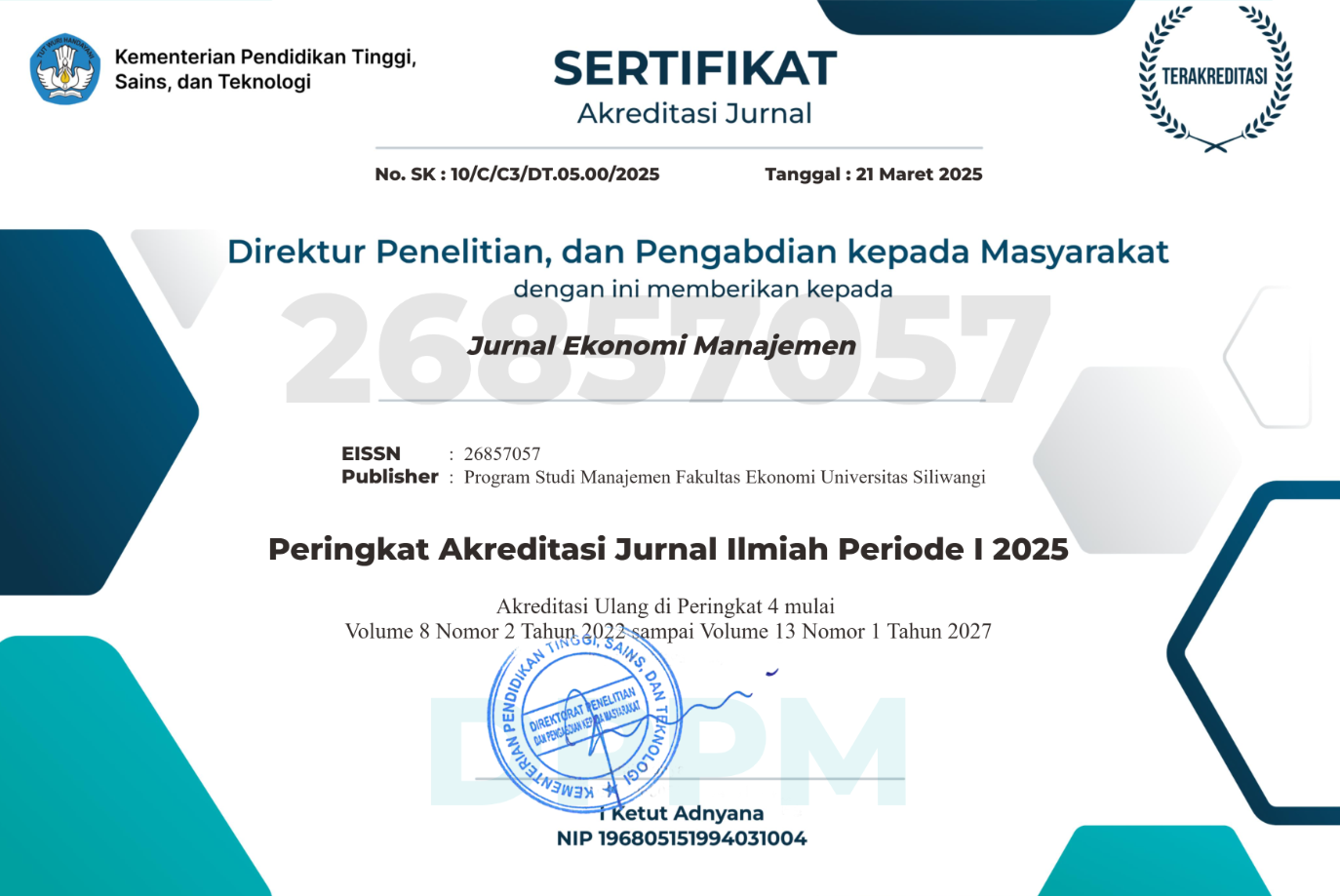
Sertifikat Akreditasi Sinta 4
NO. SK: 10/C/C3/DT.05.00/2025
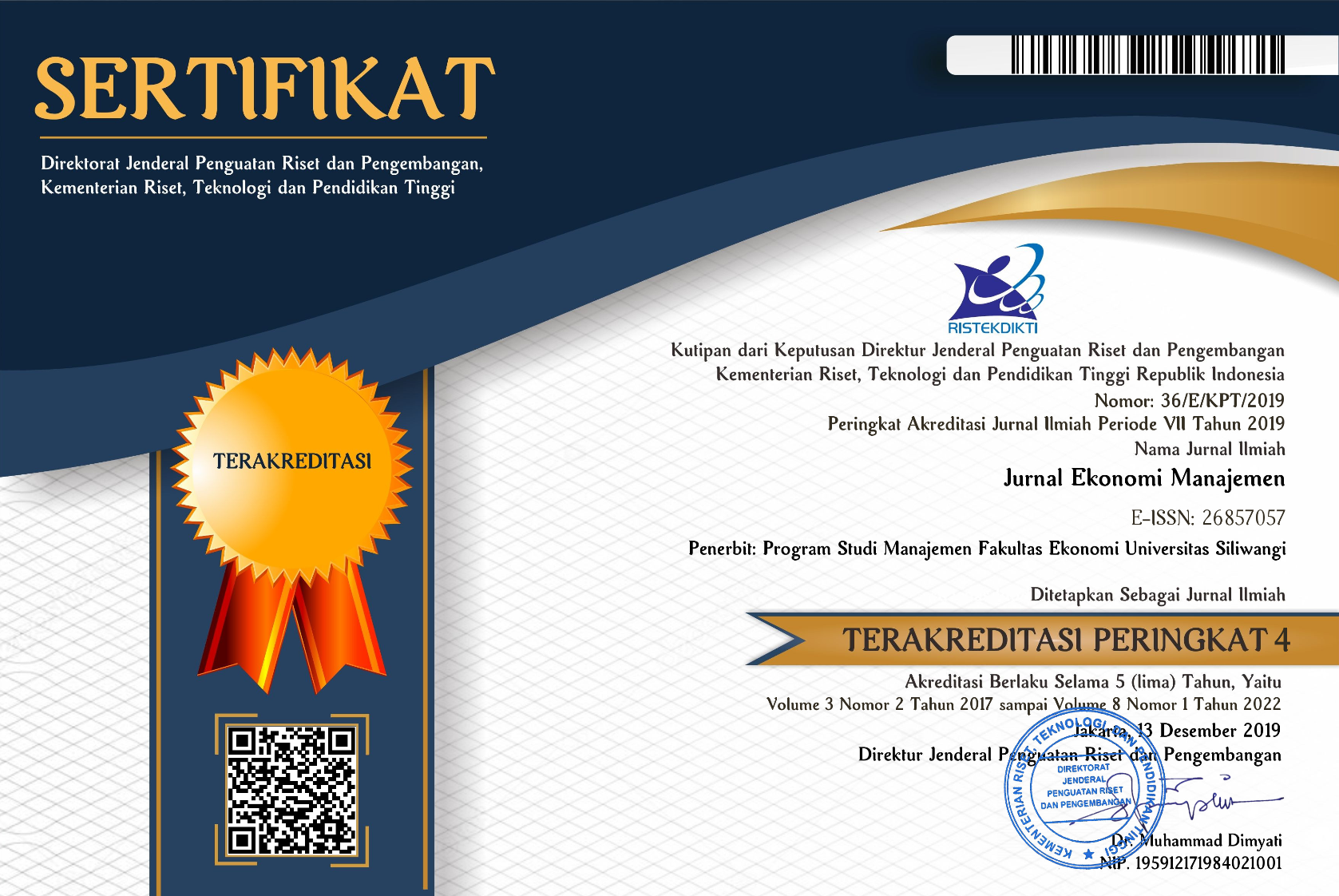
No. SK: 36/E/KPT/2019

When submitting a manuscript, authors are required to observe the following requirements:
Type the title of your articles (Times New Roman 16)
First Author1,*, Second Author2
1First author's affiliation (Department, Faculty, University, City, Country)
2Second author's affiliation (Department, Faculty, University, City, Country)
Correspondence author: *[email protected]
ABSTRACT (Times New Roman 12)
Write abstract in good English. Use TNR 11 with one spacing between lines, justified, consists of: purpose (contains objectives of the research), method (delivers data collection of the research), results and impact of the research (refers to collected data as an effort to answer research question). The number of words should be between 150-250 words.
Keywords: keyword 1; keyword 2; keyword 3.
Authors should choose five specific keywords accurately reflecting the article's content, which should be provided after the abstract.
JEL Classification: M41, M42 (See https://www.aeaweb.org/jel/guide/jel.php)
INTRODUCTION (Times New Roman 12)
The Introduction should present a clear and coherent argument that leads the reader from the general research context to the specific objectives of the study. The author is expected to explain the background of the research phenomenon and its importance from both theoretical and practical perspectives. Relevant previous studies should be reviewed to identify limitations, inconsistencies, or unresolved issues that form the basis of the research gap. The theoretical foundations used to address this gap should then be described, followed by a clear explanation of the novelty and contribution of the study. The author must clearly formulate the research problem and objectives, and when applicable, develop the research hypotheses based on recent empirical findings and established theories. The logical reasoning underlying the formulation of each hypothesis should be clearly articulated, and the conceptual framework may be briefly described. This section should be written as an integrated narrative without subheadings and supported by relevant and up-to-date references.
METHOD
The method section describes the overall research design, including the research approach, data sources (both primary and secondary), data collection procedures, data analysis techniques, and the measurement of research variables. All methodological aspects should be presented clearly and systematically in paragraph form.
RESULTS AND DISCUSSION
Results
The Results section should present the research findings based on the collected data obtained through questionnaires, surveys, documents, interviews, observations, or other relevant data collection techniques. The author is required to report the empirical results clearly and concisely, including descriptive statistics and, where applicable, hypothesis testing results. The presentation should focus on the main findings without excessive interpretation. Tables and figures may be used to support the explanation, but they should be properly referenced and integrated into the narrative. The results must be reported objectively and systematically, avoiding repetition and unnecessary elaboration.
Discussion
The Discussion section should interpret and analyze the findings presented in the Results section. The author is expected to explain the significance of the results in relation to the research objectives and theoretical framework. This section should demonstrate analytical depth by linking the findings to relevant theories and previous studies, highlighting similarities, differences, and contributions. The novelty and implications of the research should be clearly articulated. Authors are advised to avoid repeating the results and to limit extensive literature reviews in this section. The discussion should emphasize the meaning of the findings and their relevance to both theory and practice.
CONCLUSION
The Conclusion section should summarize the main findings of the study in relation to the research objectives and research questions. This section must provide clear answers based on the results and discussion, highlighting the key contributions of the study. The author should briefly describe the theoretical and managerial implications of the findings and explain their relevance to both academic development and practical application. In addition, the author is encouraged to acknowledge the main limitations of the study and provide directions for future research. The conclusion should be written in a coherent paragraph, without statistical expressions and without citations.
Author Contribution
This section should specify the contribution of each author to the research and manuscript preparation.
Funding Statement
This section should describe the source of funding, whether provided by an institution, grant scheme, or self-funded.
Acknowledgments
Authors may acknowledge individuals or organizations that provided assistance during the research and publication process.
Conflicts of Interest
The authors declare that there is no conflict of interest related to this study.
REFERENCES
The manuscript should contain a minimum of 50 references, with at least 80% published within the last ten years. The majority of the references, at least 80%, must be primary sources from national and international research articles. Authors are encouraged to limit self-citations to no more than three publications. All references must follow the 7th edition of the American Psychological Association (APA) style. To ensure accurate citation and reference management, authors are advised to use reference management software such as Mendeley.
Example:
Citation:
References:
Coe, E., & Enomoto, K. (2024, May 13). In search of self and something bigger: A spiritual health exploration. Retrieved December 20, 2025, from McKinsey Health Institute: https://www.mckinsey.com/mhi/our-insights/in-search-of-self-and-something-bigger-a-spiritual-health-exploration#/
Maxwell, J. C. (2023). The ultimate guide to developing leaders. HarperCollins Leadership.
Ramadhani, I., Santoso, B., & Sobandi, A. (2025). Exploring a Global Trends of Research on Employee Resilience: A Bibliometric Analysis. Proceedings of the 9th Global Conference on Business, Management and Entrepreneurship (GCBME 2024) (pp. 814-820). Atlantis Press. doi:https://doi.org/10.2991/978-94-6463-817-2_96
WEF. (2025). Future of Jobs Report 2025. Cologny/Geneva: World Economic Forum. Retrieved from https://www.weforum.org/publications/the-future-of-jobs-report-2025/in-full/
Yin, H., & Liu, J. (2026). Resilient leadership in female principals: a case study of a Chinese female school leader. Frontiers in Education, 10 - 2025, 1-10. doi:https://doi.org/10.3389/feduc.2025.1718038
Submission Preparation Checklist
Sertifikat Akreditasi Sinta 4
NO. SK: 10/C/C3/DT.05.00/2025
No. SK: 36/E/KPT/2019






Jurnal Ekonomi Manajemen by Management Study Program Faculty of Economic and Business Universitas Siliwangi is licensed under a Creative Commons Attribution-ShareAlike 4.0 International License.