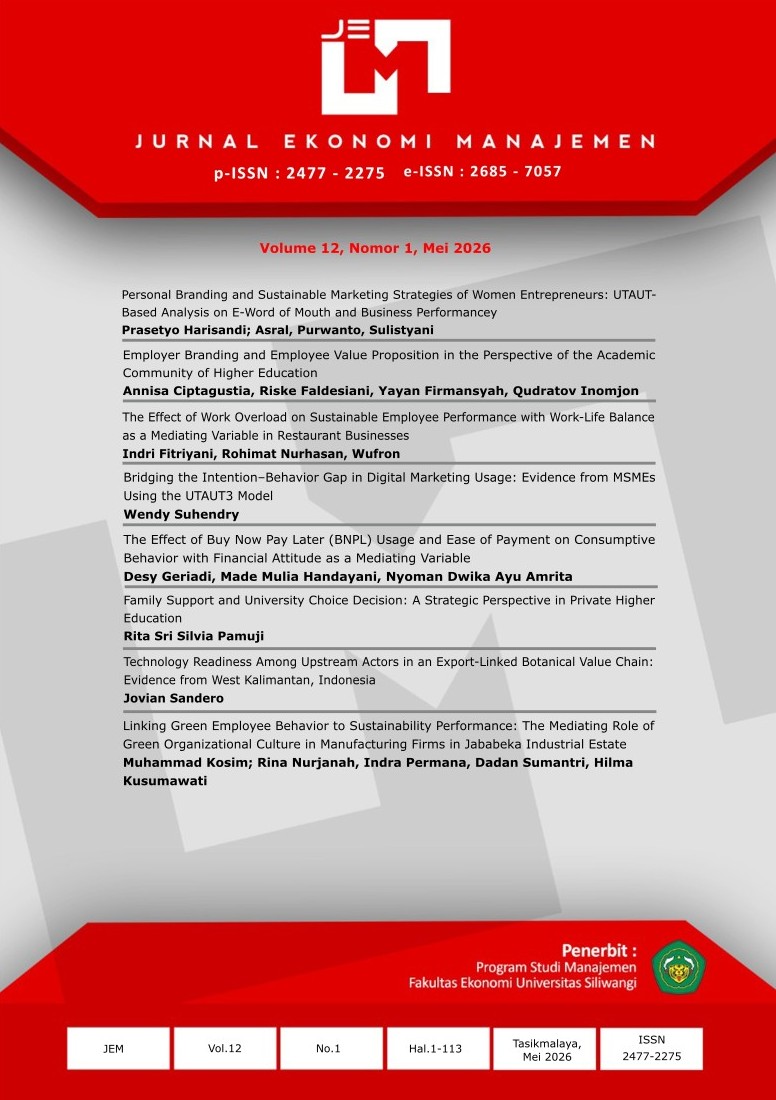
Technology Readiness Among Upstream Actors in an Export-Linked Botanical Value Chain: Evidence from a Regency in West Kalimantan, Indonesia
DOI:
https://doi.org/10.37058/jem.v12i1.246Keywords:
technology readiness, digitalization, agricultural value chain, smallholder, West KalimantanAbstract
This study examines technology readiness among upstream actors in an export-linked, smallholder-based botanical value chain in a regency in West Kalimantan, Indonesia. Prior TRI studies largely focus on services, education, and urban MSMEs, leaving limited evidence on upstream export-linked value chains where first-mile constraints, trust boundaries, and traceability-related information exposure can shape technology perceptions. Using the Technology Readiness Index (TRI), this study addresses that gap by providing a baseline profile of readiness drivers and inhibitors to inform staged and trust-sensitive digitalization strategies. Primary data were collected in June 2025 through a cross-sectional field survey of 60 upstream actors recruited via purposive sampling. TRI was measured across four dimensions: optimism and innovativeness (drivers), and discomfort and insecurity (inhibitors). Reliability was assessed using Cronbach’s alpha at the dimension level, with one ambiguous discomfort item excluded to improve internal consistency. Results indicate an ambivalent readiness configuration: optimism and innovativeness were high, while discomfort and insecurity were also high, reflecting substantial concerns related to difficulty, risk, and trust. The findings imply that upstream digitalization is shaped by a value-risk tension rather than perceived usefulness alone. Future research should validate TRI in similar upstream settings with larger samples and link readiness profiles to observed technology use and operational outcomes.
Downloads
Published
Issue
Section
Categories
License
Copyright (c) 2026 Jurnal Ekonomi Manajemen

This work is licensed under a Creative Commons Attribution-ShareAlike 4.0 International License.