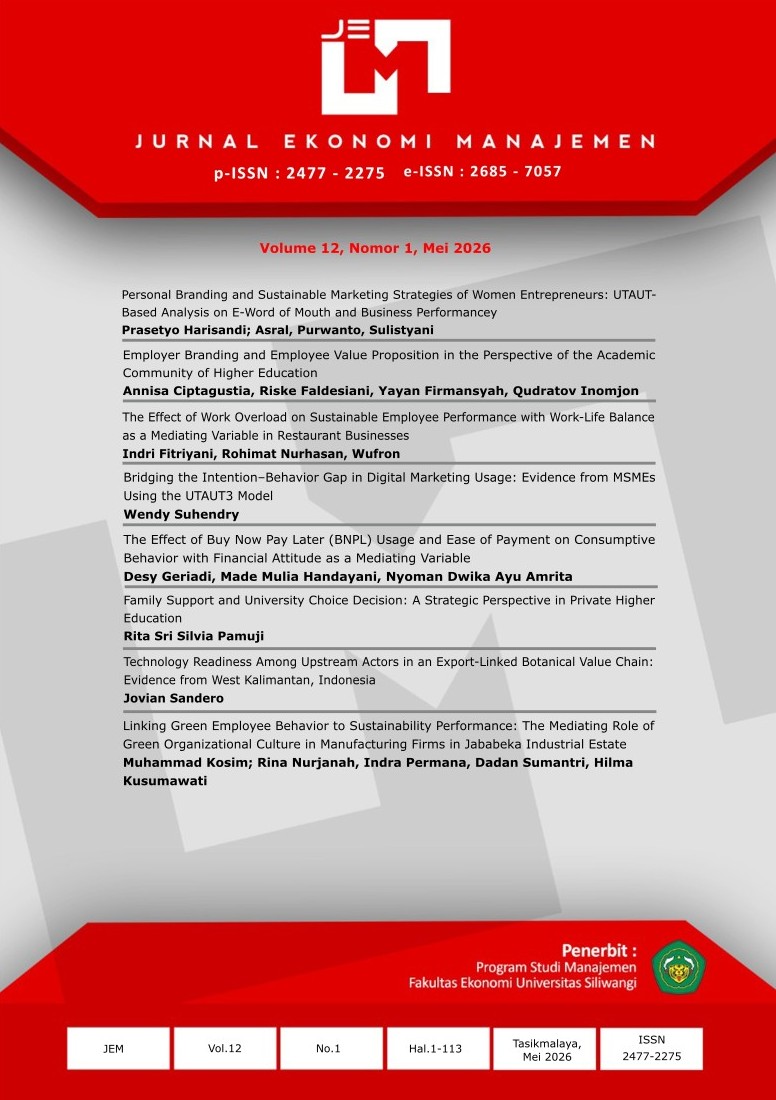
The Effect of Work Overload on Sustainable Employee Performance with Work-Life Balance as a Mediating Variable in Restaurant Businesses
DOI:
https://doi.org/10.37058/jem.v12i1.348Keywords:
Workload, work-life balance, sustainable employee performance, human resources, restaurantsAbstract
This study examines the relationship between work overload, work-life balance, and sustainable employee performance among restaurant employees. The study is motivated by inconsistent findings regarding the direct effect of work overload on performance, limited research in restaurant contexts, and the relatively low attention given to sustainable employee performance compared to conventional performance. A quantitative approach was employed using data from 98 respondents selected through purposive sampling. The data were analyzed using a structural equation modeling approach to test the relationships among variables and mediation effects. The results indicate that work overload does not have a significant direct effect on sustainable employee performance. However, work overload significantly affects work-life balance, which in turn has a significant positive effect on sustainable employee performance. Work-life balance fully mediates the relationship between work overload and sustainable employee performance. These findings suggest that performance sustainability in restaurant settings is not directly determined by workload, but rather by employees’ ability to maintain work-life balance. This study contributes theoretically by integrating Job Demands–Resources and Conservation of Resources perspectives, and practically highlights the importance of work-life balance in supporting sustainable employee performance.
Downloads
Published
Issue
Section
Categories
License
Copyright (c) 2026 Jurnal Ekonomi Manajemen

This work is licensed under a Creative Commons Attribution-ShareAlike 4.0 International License.